

Understanding the Costs of Rhinoplasty Surgery
Rhinoplasty costs depend on the planned changes, the surgeon, and what the quoted fee includes. For Boston patients, published practice prices offer useful starting points, but they are not interchangeable or a substitute for an individual estimate. This article explains local pricing examples, treatment differences, and the questions that help you build a realistic budget.
How much does rhinoplasty cost in Boston, MA?
Published Boston-area rhinoplasty prices include a $12,000–$20,000 range at Lee Facial Plastic Surgery and a starting price of $20,000 at Boston Center for Plastic Surgery. These are individual practices’ advertised prices, not a verified citywide average. Your total may differ after an examination and surgical planning.
The distinction matters when researching rhinoplasty cost in Boston, MA: a starting price, an estimated range, and an all-inclusive quote answer different questions. Boston Center for Plastic Surgery states that its advertised starting price includes surgeon, anesthesia, and facility fees. Ask every practice to confirm its own inclusions rather than assuming the same arrangement applies everywhere.
For national context, the American Society of Plastic Surgeons lists an average rhinoplasty surgeon’s fee of $7,637. That figure excludes anesthesia, operating facilities, and other related expenses, so it should not be treated as a complete Boston surgery budget.
Use published numbers to prepare for consultations—not to decide that a higher or lower quote must be wrong. First establish whether the proposed operation and included services are comparable.
Separate the surgical bill from your overall budget
A useful rhinoplasty price accounts for more than the operation itself. ASPS identifies surgeon fees, anesthesia, surgical facilities, medical tests, prescriptions, and postoperative items as possible cost components. Request an itemized estimate so you can distinguish included services from expenses billed separately.
Use this checklist when reviewing the paperwork:
| Budget item | What to clarify |
|---|---|
| Surgeon’s fee | What to clarifyWhich planned cosmetic and functional changes are included? |
| Anesthesia | What to clarifyIs the anesthesia provider’s charge included, and can it change? |
| Operating facility | What to clarifyIs the facility fee bundled or billed separately? |
| Testing and medication | What to clarifyWhich tests, prescriptions, and supplies will you purchase separately? |
| Follow-up care | What to clarifyWhich postoperative visits are included, and for how long? |
| Unexpected treatment | What to clarifyHow are additional visits, complications, or another operation billed? |
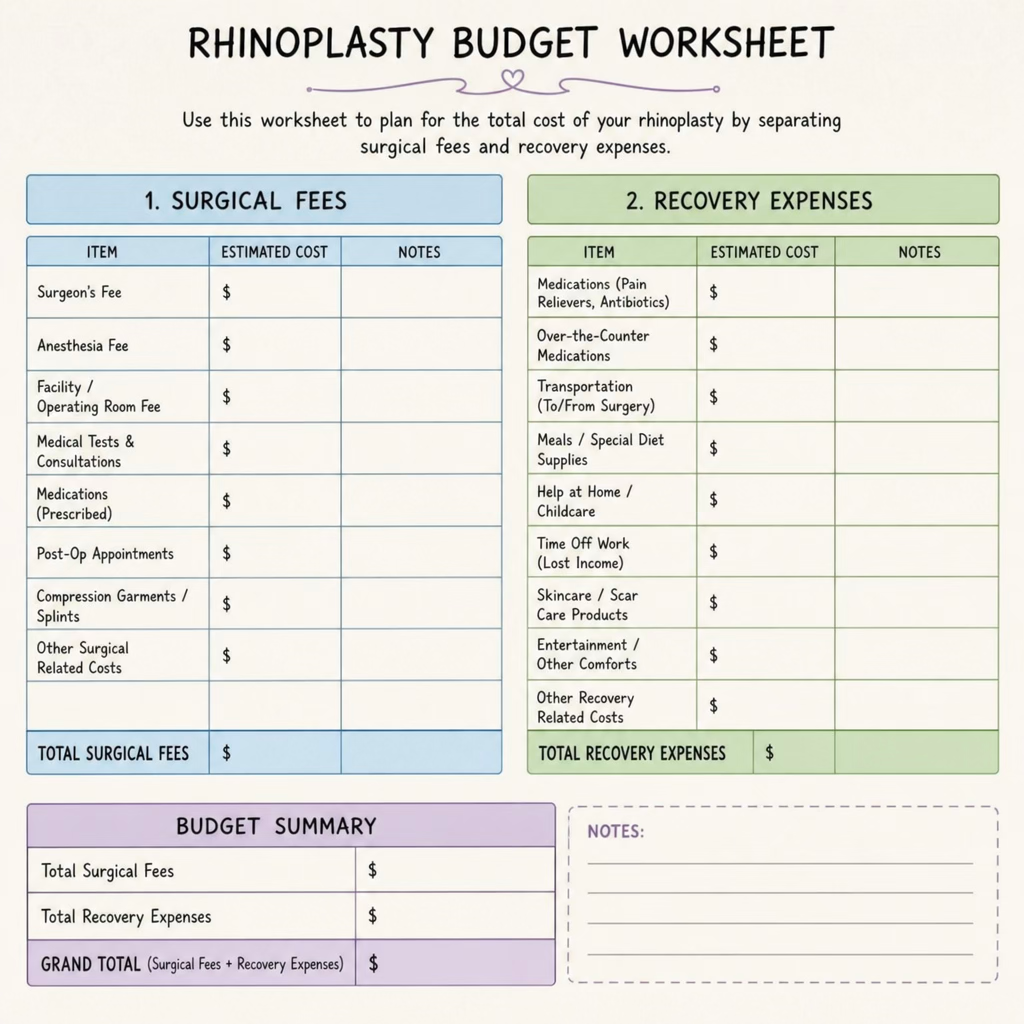
Also create a separate recovery budget. Consider transportation, parking, help at home, and any income you would lose while away from work. Mayo Clinic advises arranging a ride home and having someone stay with you briefly after surgery; ask your surgeon how much assistance your circumstances require.
The treatment plan explains price differences
Two people requesting a smaller-looking nose may need different operations. One may need limited reshaping, while another needs changes to bone and cartilage or additional structural support. Rhinoplasty can involve removing tissue, adding cartilage grafts, and correcting a deviated septum, depending on the patient’s needs.
Ask the surgeon to connect each recommended change to your priorities. For example, if grafting is proposed, ask what it is intended to support and where the cartilage would come from. This makes the estimate easier to understand than a list of unfamiliar procedure names.
Surgeon training, experience, procedural complexity, and geography can also affect cost. A higher price alone does not establish that a surgeon is the right fit. Look for relevant board certification, regular rhinoplasty experience, and an accredited surgical facility or hospital, alongside a clear discussion of realistic outcomes.
The practical goal is to understand what you are paying for—not to assume that either the lowest or highest figure represents the best value.
Is closed rhinoplasty cost lower than open rhinoplasty?
Closed rhinoplasty is not automatically the less expensive choice. Open and closed describe surgical access, while the fee also reflects the work required and the surgeon’s pricing. Neither label alone provides enough information to predict your final bill.
In a closed procedure, incisions are inside the nose. An open procedure adds an incision across the columella, the narrow tissue separating the nostrils. Both approaches provide access to reshape underlying nasal structures; the appropriate approach depends on the treatment plan.
Rather than requesting closed surgery simply to reduce cost, ask why the surgeon recommends a particular approach. Have them explain how it supports the planned changes and whether another approach would alter the scope or estimate. Compare complete proposals, not incision labels.
Revision surgery needs a separate estimate
Revision rhinoplasty addresses a nose that has already undergone surgery. Scar tissue, reduced available cartilage, and changes to nasal support can make these operations especially challenging. Some patients need cartilage from the ear or rib to rebuild support.
Those differences can raise the price above primary surgery. For example, a revision practice explains that longer operating time, cartilage harvesting, grafting, and work through scarred tissue contribute to higher fees. A fixed percentage increase is not a reliable substitute for an individualized estimate.
If you have had previous nasal surgery, bring available operative records and explain both appearance and breathing concerns. Ask which parts of the plan are predictable and which may depend on findings during surgery. Also request written clarification of the practice’s revision policy, including any separate anesthesia or facility charges.
Can insurance cover part of nose surgery?
Insurance may cover medically necessary nasal surgery that improves breathing, but cosmetic reshaping generally remains a personal expense. Coverage depends on the policy and documentation supporting the functional treatment. Combining cosmetic and functional work does not make the entire operation covered.
For a combined procedure, request separate explanations of the cosmetic charges and insurance-billed services. Ask the office what examination findings and prior authorization your insurer requires. Then confirm your expected responsibility directly with the insurer before scheduling.
Use these questions to organize that conversation:
- Which proposed services are being submitted as medically necessary?
- Are the surgeon, facility, and anesthesia provider in network?
- What deductible, copayment, or coinsurance could apply?
- How will shared operating-room and anesthesia charges be allocated?
- What would you owe if the insurer denies a claim?
Keep written authorization and estimates together. Mayo Clinic cautions that prior authorization is not a guarantee of coverage, so avoid budgeting as though approval eliminates all uncertainty.
Financing changes the payment schedule, not the price
Medical credit cards and installment financing can spread payments over time, but interest and fees may increase the total you repay. The Consumer Financial Protection Bureau recommends reviewing interest rates, payment schedules, processing charges, and other terms before signing.
Be especially careful with deferred-interest promotions. If the balance is not fully repaid before the promotional deadline, interest may be charged back to the original purchase date. Minimum payments alone may not clear the balance in time.
Compare the cash price with the full financed repayment amount. Work out a payment you can manage alongside ordinary expenses and a recovery reserve. If the plan only works under ideal circumstances, consider saving longer rather than letting a promotional deadline determine your surgery date.
Liquid rhinoplasty is a different decision
Injectable filler can camouflage selected contour irregularities, but it adds volume rather than making the nose physically smaller. Results are temporary, and filler does not replace surgery for structural breathing problems. Its shorter-term price therefore should not be compared with surgical rhinoplasty as though the treatments accomplish the same thing.
There are also important safety limitations. The FDA has not approved dermal fillers for injection into the nose and recommends against that use. Accidental injection into a blood vessel can cause tissue death, blindness, or stroke. Discuss these risks with a qualified clinician rather than treating filler as a harmless budget alternative.
Compare rhinoplasty quotes with the same questions
Before choosing, place each written estimate beside its proposed treatment plan. Mark every unclear inclusion and ask the office to resolve it. A quote is only useful when you understand both the procedure and your financial responsibility.
When comparing rhinoplasty cost in Boston, focus on complete information: the planned changes, clinical qualifications, included care, possible additional charges, and realistic recovery arrangements. The strongest budget is not simply the smallest number. It is one you understand well enough to make an informed, unhurried decision.
Frequently Asked Questions About Rhinoplasty Costs
1. How much does rhinoplasty cost in Boston, MA?
Rhinoplasty costs in Boston vary depending on the surgeon, procedure complexity, and included services. Published prices at selected Boston-area practices range from approximately $12,000 to $20,000, while some practices advertise starting prices of $20,000 or more. These figures are not a citywide average. A personalized consultation is necessary to determine the estimated total cost of your surgery.
2. What factors affect the total cost of rhinoplasty surgery?
Several factors influence rhinoplasty pricing, including the surgeon’s experience, surgical complexity, anesthesia fees, operating facility charges, and geographic location. Procedures requiring cartilage grafting, significant structural modifications, or breathing corrections may involve additional surgical work. The most reliable way to understand your rhinoplasty cost is to request an individualized treatment plan and an itemized financial estimate.
3. What is included in the price of rhinoplasty?
A rhinoplasty quote may include the surgeon’s fee, anesthesia, operating room expenses, and postoperative appointments. However, medical tests, prescription medications, surgical supplies, and additional treatment may be billed separately. Before scheduling surgery, request a written breakdown of all anticipated expenses and ask whether the quoted amount is comprehensive or subject to additional charges.
4. Is closed rhinoplasty cheaper than open rhinoplasty?
Closed rhinoplasty is not necessarily less expensive than open rhinoplasty. Although closed rhinoplasty uses incisions inside the nostrils, the total surgical cost depends primarily on the complexity of the procedure and the surgeon’s treatment plan. Open rhinoplasty may be recommended when greater access to nasal structures is necessary. The most appropriate technique should be selected according to your anatomy and surgical goals, not price alone.
5. Why is revision rhinoplasty often more expensive than primary rhinoplasty?
Revision rhinoplasty can be more complex because previous surgery may have created scar tissue, altered nasal anatomy, or reduced available cartilage. Some patients require additional cartilage grafts or structural reconstruction. These factors can increase operating time and surgical costs. Revision rhinoplasty pricing should therefore be determined through an individual assessment rather than a fixed percentage above the cost of primary surgery.
6. Does health insurance cover rhinoplasty surgery?
Health insurance generally does not cover rhinoplasty performed solely for cosmetic purposes. However, medically necessary procedures intended to correct functional breathing problems may qualify for partial or full coverage, depending on the insurance policy. A detailed examination, supporting medical documentation, and prior authorization may be required. Patients should confirm coverage, deductibles, and expected out-of-pocket expenses directly with their insurance provider.
7. Can septoplasty and cosmetic rhinoplasty be performed together?
Yes. Septoplasty and cosmetic rhinoplasty can sometimes be performed during the same operation when both functional and aesthetic corrections are appropriate. Insurance may cover eligible medically necessary treatment while the cosmetic portion remains an out-of-pocket expense. Patients should request a clear explanation of how surgeon, anesthesia, and facility charges will be divided between covered and noncovered services.
8. Are rhinoplasty consultation fees included in the surgery cost?
Consultation fee policies vary between practices. Some surgeons charge a separate consultation fee, while others may apply that amount toward the procedure if surgery is scheduled. Patients should ask about consultation costs, cancellation policies, required deposits, and whether the initial surgical estimate may change following additional examinations or treatment planning.
9. How much time should I take off work after rhinoplasty?
Many patients should plan approximately one week away from work or school after rhinoplasty, although individual recovery requirements vary. Swelling and bruising can persist beyond the initial recovery period, and physically demanding jobs may require additional time off. When calculating the total financial impact of rhinoplasty, consider potential lost income, transportation, and assistance needed during recovery.
10. Are follow-up appointments and additional procedures included in rhinoplasty pricing?
Not always. Some practices include routine postoperative appointments in their surgical packages, while others charge separately for certain visits or treatments. Additional surgery, if needed, may involve separate surgeon, anesthesia, or facility fees. Before proceeding, ask how long follow-up care is included and request written information about complication-related expenses and the surgeon’s revision policy.
11. Can I finance rhinoplasty surgery in Boston?
Some Boston-area plastic surgery practices offer financing options through medical credit providers or installment payment programs. These arrangements may make payments more manageable, but interest rates, administrative fees, and repayment conditions can increase the total cost. Patients should compare the full repayment amount with the cash price and carefully review any deferred-interest promotional terms before committing.
12. Is liquid rhinoplasty a cheaper alternative to surgical rhinoplasty?
Liquid rhinoplasty may have a lower initial price than surgery, but it serves a different purpose. Injectable fillers can temporarily camouflage selected contour irregularities, whereas surgical rhinoplasty can reshape nasal structures. Fillers cannot physically reduce nose size or correct structural breathing problems. Importantly, the FDA has not approved dermal fillers for injection into the nose and warns of serious risks, including tissue damage, blindness, and stroke.
13. How can I compare rhinoplasty prices between different surgeons?
Start by requesting written estimates that describe the proposed surgical changes and all included fees. Compare surgeon qualifications, rhinoplasty experience, anesthesia arrangements, surgical facility standards, follow-up care, and potential additional expenses. A lower advertised price does not necessarily mean a lower final cost. Choosing a surgeon should involve evaluating clinical expertise, safety, communication, and realistic treatment expectations alongside the financial estimate.