
Revision Nose Skin Release: Preparing Contracted Nasal Skin Before Revision Rhinoplasty
Quick answer: Revision Nose Skin Release is a staged soft-tissue preparation and remodeling approach for selected revision rhinoplasty patients whose nasal skin has become tight, stiff, less mobile or scarred after previous surgery or infection. Within Dr. Emre İlhan’s Enzymatic Nasal Skin Release Protocol, the aim is to improve the quality and flexibility of the nasal soft-tissue envelope before reconstruction and to support tissue remodeling during recovery. It does not replace revision rhinoplasty, and suitability can only be determined after a detailed examination.
Revision rhinoplasty is not only a matter of rebuilding cartilage and bone. The skin and soft tissues covering the nasal framework must also be able to move, settle and adapt to the new structure. When the soft-tissue envelope is healthy and flexible, the surgeon has a more favorable environment in which to plan reconstruction. When that envelope is contracted or heavily scarred, the operation may become more complex.
This is the reason Dr. Emre İlhan’s protocol begins with the condition of the skin. The principle is simple: first release and prepare the skin; then rebuild the nose.
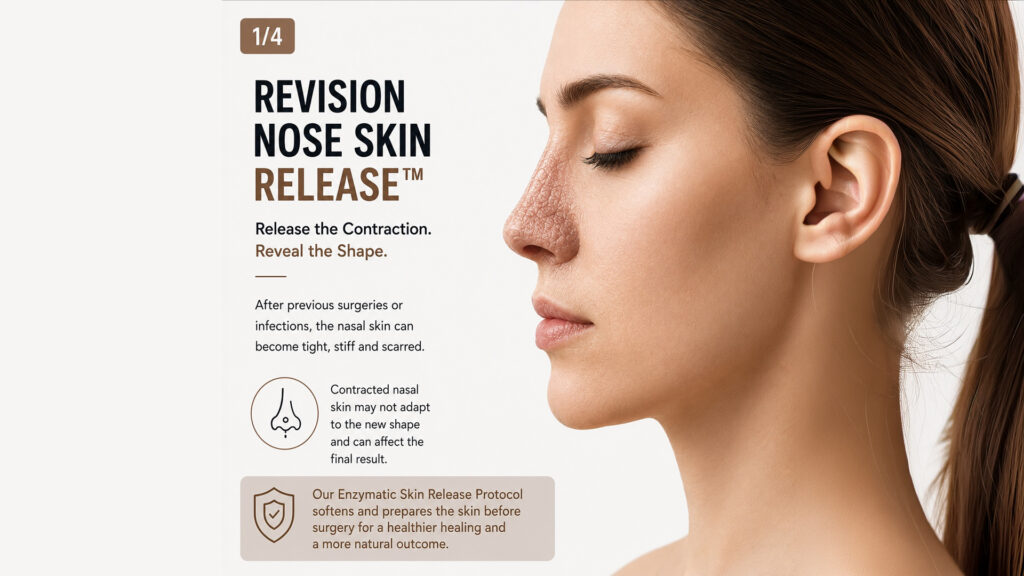
Contracted nasal skin and the rationale for preoperative skin preparation.
Why Can Nasal Skin Become Tight After Previous Surgery?
A nose that has already been operated on does not present the same tissue conditions as a primary rhinoplasty nose. Previous surgical dissection, accumulated scar tissue, reduced soft-tissue flexibility and a history of infection can all be relevant. In some patients, scar tissue contracts as it matures. The nasal skin may then feel firm, tethered or difficult to move.
The visible shape of the nose may also be affected because a contracted soft-tissue envelope may not drape smoothly over the underlying framework. Even when the cartilage and bone are reconstructed precisely, stiff skin may be less capable of adapting to the intended contours. For that reason, tissue quality is assessed as part of revision planning rather than treated as an afterthought.
Signs Considered During a Revision Assessment
During examination, the surgeon evaluates whether the nasal skin appears tight, stiff, thickened, adherent or unevenly mobile. The amount and distribution of scar tissue, the number and type of previous operations, earlier infections, skin quality and the patient’s individual healing response are also considered. None of these findings can be evaluated accurately through a photograph alone.
What Is the Enzymatic Nasal Skin Release Protocol?
The Enzymatic Nasal Skin Release Protocol is a staged treatment concept designed for selected patients with contracted or scarred nasal soft tissue. It focuses on conditioning the nasal skin and soft-tissue envelope before reconstruction and supporting remodeling after surgery. Applications are planned at carefully selected tissue layers according to the patient’s examination and surgical requirements.
The protocol uses a specialized combination of collagenase, lipase and lyase. In the protocol framework, these enzymes have different intended roles in scar and soft-tissue remodeling. The purpose is not to create a standard result for every patient. It is to create a more favorable tissue environment for an individualized revision plan.
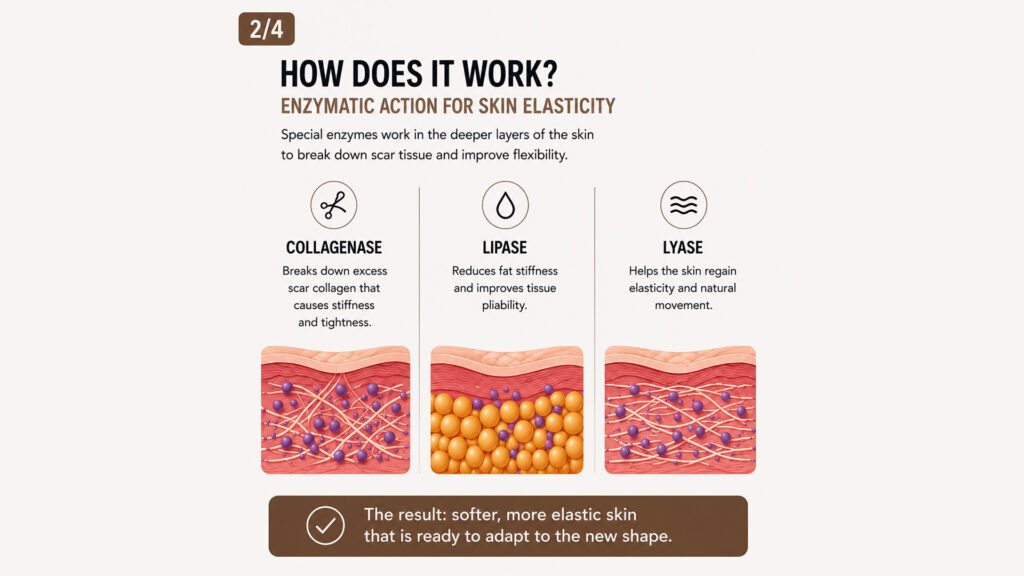
Protocol mechanism (2/4): the intended roles of collagenase, lipase and lyase in soft-tissue preparation.
How Do the Three Enzymatic Components Work Within the Protocol?
Collagenase: Addressing Excess Scar Collagen
Scar tissue can contain dense or excessive collagen that contributes to stiffness and tightness. Within the protocol, collagenase is used with the intention of softening contracted scar tissue and improving tissue pliability. The application is planned precisely because the amount, location and depth of scar tissue differ from one revision patient to another.
Lipase: Supporting Tissue Pliability
Soft-tissue stiffness is not always limited to one layer. Lipase is included in the enzymatic combination to support a softer, more pliable tissue environment where indicated. It is not presented as a weight-loss or cosmetic fat-removal treatment; its role is specific to the nasal soft-tissue plan developed for revision surgery.
Lyase: Supporting Elasticity and Natural Movement
Lyase is used within the protocol to support flexibility and more natural tissue movement. The clinical objective is a nasal envelope that is better able to accommodate the reconstructed framework and remain mobile during the healing and remodeling process.
Clinical principle: The enzymes are not a stand-alone substitute for surgery. They form part of a surgeon-led protocol for carefully selected revision rhinoplasty patients.
Your Treatment Journey: A Staged and Individualized Plan
The visual journey below shows how treatment may be distributed across the preoperative, surgical and postoperative periods. It illustrates an initial application before surgery, a perioperative application, early postoperative support and a later remodeling stage when needed. The exact dates and number of sessions are not automatically identical for every patient.
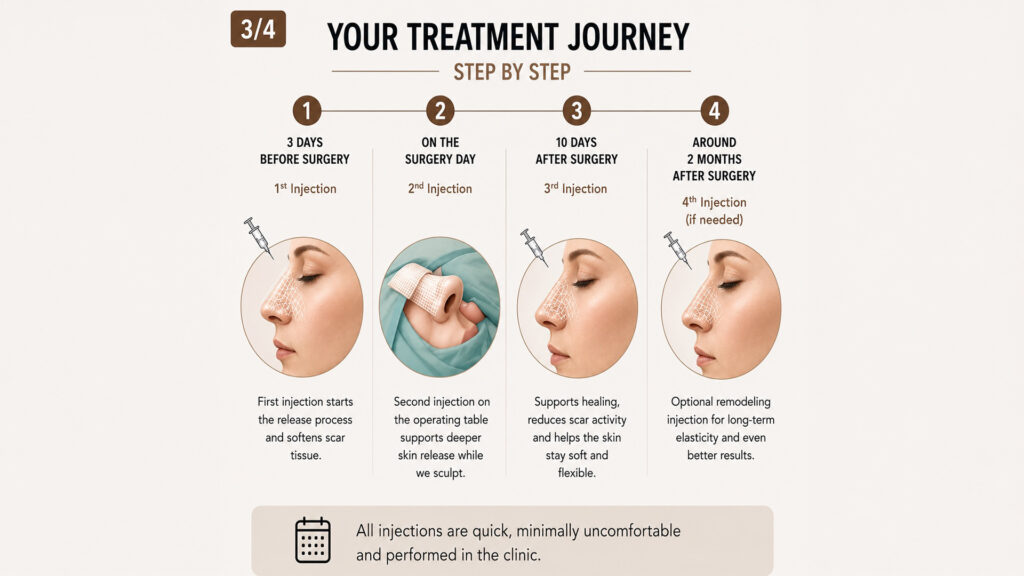
Illustrative treatment journey (3/4): staged applications may be planned before surgery, on the surgical pathway and during recovery.
Stage 1 – Preoperative Skin Release
The first stage begins before revision rhinoplasty. Its purpose is to start conditioning contracted or scarred tissue and to improve the mobility of the nasal skin. The application pattern and tissue layers are determined by examination. Some patients require a staged preoperative approach; the protocol is adapted to the condition of the soft-tissue envelope rather than applied as a one-size-fits-all injection schedule.
Stage 2 – Revision Rhinoplasty and Reconstruction
Once the tissues have been assessed and prepared, revision rhinoplasty is performed according to an individualized surgical plan. Dr. Emre İlhan considers the patient’s previous operations, current nasal framework, scar distribution, skin quality, soft-tissue mobility and reconstructive needs. Preparing the envelope first is intended to provide a more favorable environment for rebuilding the cartilage and bone framework.
Stage 3 – Early Postoperative Support
During the early recovery period, the nose is monitored closely. Where clinically indicated, a postoperative application may be used to support healthy scar remodeling and help the tissues remain soft and flexible. The timing depends on healing, examination findings and the surgeon’s assessment; patients should not compare their schedule with another person’s treatment calendar.
Stage 4 – Later Remodeling When Needed
A later remodeling session may be considered when the evolving tissue response suggests that additional support could be useful. This stage is optional and is not required for every patient. The decision is based on how the skin, scar tissue and soft-tissue envelope behave as healing progresses.
Why Skin Preparation Matters in Revision Rhinoplasty
A successful revision plan must account for both the framework and the covering tissues. Cartilage and bone determine structural support, but the final contours are seen through the nasal skin. If the skin is immobile or contracted, it may resist the new shape. Improving flexibility before reconstruction may help the envelope adapt more naturally and may support a smoother healing environment.
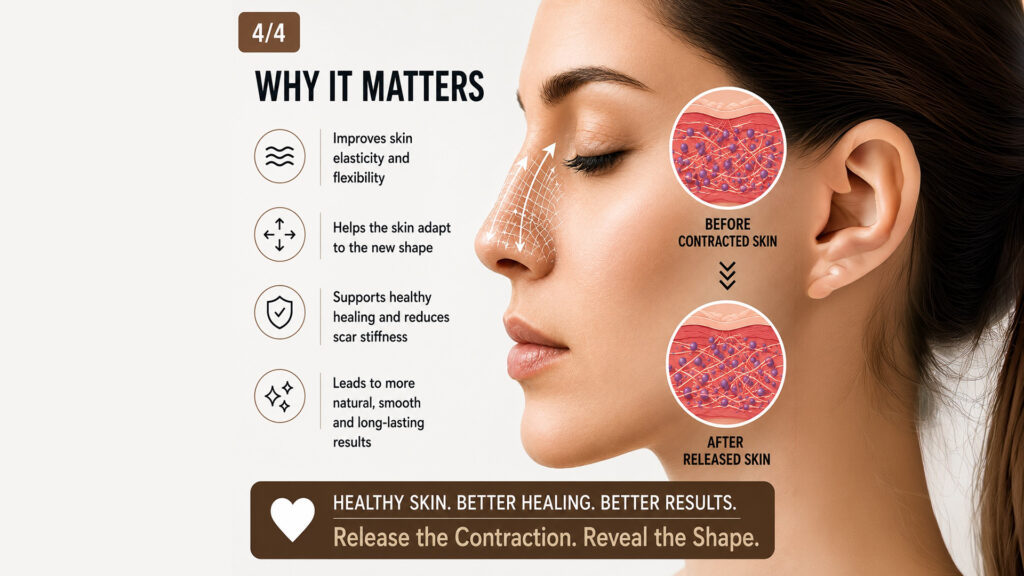
Why it matters (4/4): the protocol aims to improve flexibility, adaptation and the tissue environment for healing.
What the Protocol Is Designed to Support
Before surgery, the protocol is designed to support softer nasal skin, better tissue flexibility, improved mobility in contracted areas and a more favorable soft-tissue environment for reconstruction. These goals are especially relevant when scar stiffness may limit access, movement or adaptation.
After surgery, the protocol is designed to support healthy scar remodeling, continued tissue flexibility, soft-tissue quality and mobility during recovery. The objective is not to promise a particular appearance or healing speed. It is to support the tissue conditions involved in a complex reconstructive process.
What the Protocol Cannot Promise
No protocol can guarantee a specific aesthetic result, remove every effect of earlier surgery or make all revision cases equivalent to primary rhinoplasty. Outcomes vary according to skin characteristics, scar distribution, nasal structure, the number and type of previous operations, infection history and individual healing response.
The Enzymatic Nasal Skin Release Protocol should therefore be understood as one part of an individualized revision strategy. It may improve the tissue environment in suitable patients, but it does not eliminate the biological complexity of revision surgery.
Who May Be Evaluated for Revision Nose Skin Release?
The protocol may be considered during consultation when a patient has undergone one or more previous nasal operations and the skin or soft tissues appear tight, stiff, contracted, adherent or heavily scarred. A history of infection or reduced tissue mobility may also be relevant. Suitability is never decided by the number of previous surgeries alone.
Assessment area | What is considered |
Previous procedures | Number, type and timing of earlier rhinoplasty or nasal operations |
Scar characteristics | Location, density, stiffness and effect on tissue movement |
Nasal skin | Thickness, elasticity, surface condition and ability to adapt |
Soft-tissue mobility | Whether the skin envelope moves freely or appears tethered |
Infection history | Previous or suspected infections that may have affected tissue quality |
Healing response | How the patient formed and remodeled scar tissue after earlier procedures |
Reconstructive needs | Current structural problems and the framework required for revision |
A detailed clinical examination is essential because two noses that look similar in photographs may have very different tissue conditions. Dr. Emre İlhan evaluates the skin, scar tissue, soft-tissue mobility and prior surgical history before recommending any schedule.
Planning a Consultation With Dr. Emre İlhan
A revision consultation begins with understanding what has already been done and how the tissues have responded. If available, prior operation reports, implant or graft information and photographs from before earlier procedures may help the assessment. The clinical examination then focuses on nasal structure as well as the behavior of the skin and soft-tissue envelope.
Following assessment, the patient receives an individualized plan explaining whether skin preparation is appropriate, how the revision operation may be approached and how postoperative monitoring will be organized. A treatment calendar is confirmed only after these factors are reviewed.
Frequently Asked Questions
What is Revision Nose Skin Release?
It is a soft-tissue preparation and remodeling approach used within Dr. Emre İlhan’s Enzymatic Nasal Skin Release Protocol for selected revision rhinoplasty patients. The goal is to improve the condition, flexibility and mobility of tight or scarred nasal tissues before reconstruction and to support remodeling during recovery.
Why is nasal skin important in revision rhinoplasty?
The skin and soft-tissue envelope cover the reconstructed cartilage and bone. They must be able to move and adapt to the new framework. Contracted or stiff skin may make reshaping more difficult and can influence how contours appear during healing.
Which enzymes are included in the protocol?
The protocol uses a specialized combination of collagenase, lipase and lyase. Within the protocol, they are selected for their intended roles in scar-tissue softening, tissue pliability and flexibility. Application is planned by the surgeon according to tissue findings.
Does the protocol replace revision rhinoplasty?
No. The protocol is designed to prepare and support the soft tissues; it does not rebuild the nasal cartilage or bone framework. When reconstruction is required, revision rhinoplasty remains the surgical stage of the plan.
How many sessions will I need?
The total number and timing of sessions depend on examination findings, the surgical plan and the healing response. The four-stage journey shown on this page is an illustrative framework rather than a fixed schedule for every patient.
Is Revision Nose Skin Release suitable for every revision patient?
No. Some revision patients may not require this form of skin preparation, while others may have tissue conditions that need a different strategy. Suitability can only be decided after the nasal skin, scar tissue, mobility and prior surgical history have been examined.
What results should I expect?
The protocol aims to support tissue softness, flexibility, mobility and scar remodeling. It cannot guarantee a specific visual result. Outcomes vary according to tissue characteristics, previous procedures, infection history, reconstructive requirements and individual healing.
How can I learn whether the protocol is appropriate for me?
Schedule a detailed revision rhinoplasty consultation with Dr. Emre İlhan. Your previous operations, nasal structure, skin condition, scar characteristics, soft-tissue quality and treatment goals will be evaluated before an individualized recommendation is made.
A Tissue-First Philosophy for Complex Revision Rhinoplasty
Revision rhinoplasty begins before the operating room. In patients with tight, stiff or scarred nasal skin, preparing the soft-tissue envelope can be an important part of reconstructive planning. Dr. Emre İlhan’s approach recognizes that a nose is not rebuilt by focusing on cartilage and bone alone; the condition of the tissues covering that framework also matters.
If you are considering another nasal operation after previous surgery, an individualized examination can clarify whether Revision Nose Skin Release should form part of your treatment plan.
Schedule a consultation with Dr. Emre İlhan for an individualized assessment of your nasal skin, scar tissue, soft-tissue mobility and revision rhinoplasty requirements.
Important medical information
This page provides general patient information about a surgeon-led clinical protocol. It does not replace an in-person examination, diagnosis or individualized treatment plan. Results and recovery vary from patient to patient.