

Explore the Benefits of Nose Filler: Non-Surgical Solutions
Nose filler treatments, also known as liquid rhinoplasty or non-surgical nose reshaping, are designed to temporarily improve selected nasal contours without traditional surgery. By adding volume to specific areas, injectable fillers may help camouflage small bumps, enhance the nose bridge, and create a more balanced-looking profile. Although a non-surgical nose job typically involves a shorter recovery period than surgical rhinoplasty, it cannot reduce nose size or correct structural breathing problems. Nasal filler injections also carry serious medical risks and are not FDA-approved in the United States. Understanding the potential benefits, treatment limitations, nose filler costs, and safety considerations is essential before exploring this cosmetic option.
Understanding the Benefits of Nose Fillers
Nose fillers temporarily change the nose’s appearance by adding volume to selected areas, helping disguise small bumps or improve contour without surgery. Often called liquid rhinoplasty, this treatment offers visible changes with less recovery time than an operation, but it cannot make the nose smaller. Understanding its benefits, limitations, costs, and serious risks is essential before deciding whether it suits your goals.
What is nose bridge filler, and how does it work?
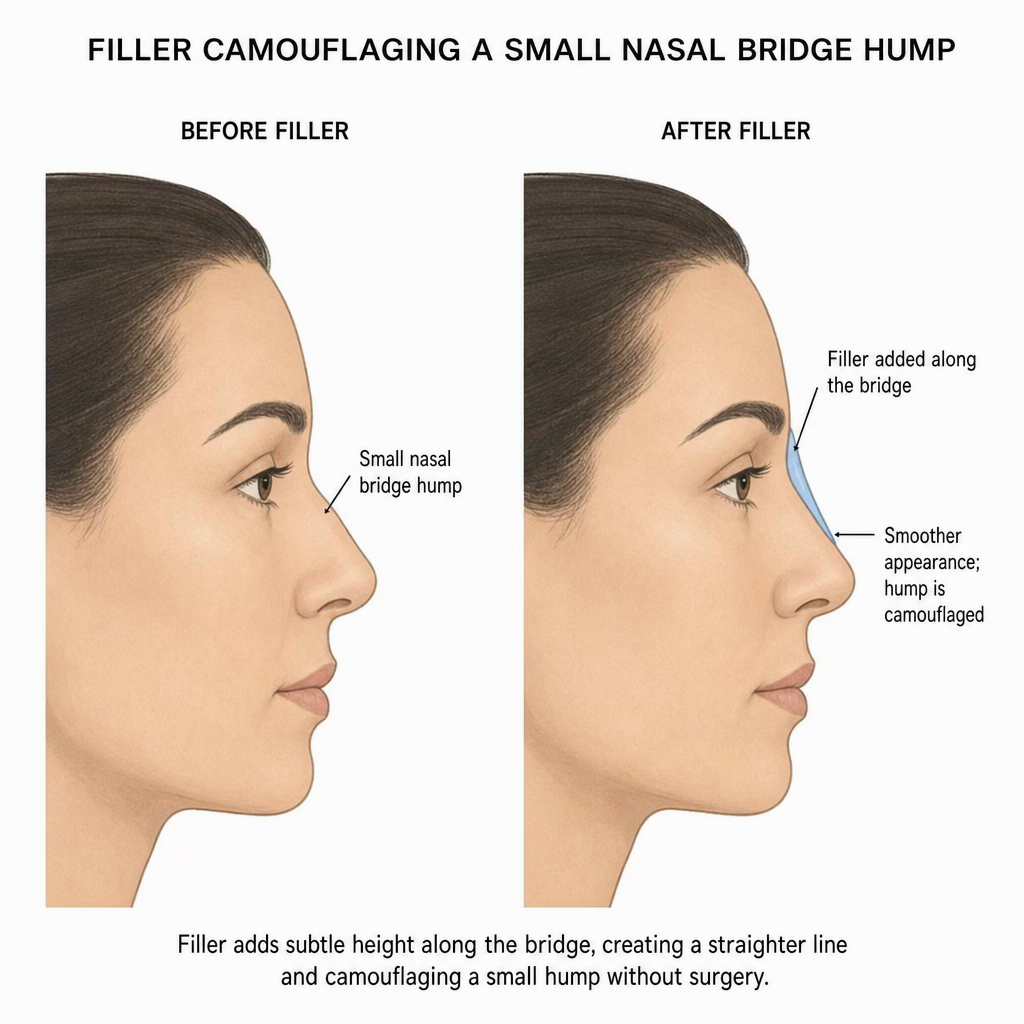
Nose bridge filler is an injectable treatment that adds volume along the upper part of the nose to improve its contour. Clinicians commonly use hyaluronic acid, a substance found naturally in the body, formulated into a gel. Carefully placed filler can fill depressions or camouflage a small hump by bringing neighboring areas closer to its height; it does not remove the hump itself.
That distinction explains how non surgical nose reshaping can create a straighter-looking profile while adding volume. A more continuous outline may appear better balanced, but the underlying bone and cartilage remain unchanged. Think of it as contour camouflage, not structural reduction.
In the United States, nasal filler injections are not FDA-approved. This is an off-label use, and the FDA specifically recommends against injecting fillers into the nose due to vascular complexity. That warning belongs in an informed discussion, not in the fine print.
The benefits are subtle changes and a shorter recovery
The appeal of a non surgical nose job is straightforward: selected cosmetic concerns can be addressed without incisions or an operation. Treatment can usually be completed during an office visit, and changes are visible immediately, although swelling can initially affect the appearance. These advantages matter most when the desired adjustment is small.
Potential benefits include:
- A smoother-looking bridge: Filling a shallow depression can soften an uneven profile without removing bone.
- Improved visual balance: Small contour adjustments may camouflage mild asymmetry rather than fully straighten the underlying nose.
- Limited interruption to daily life: Many people resume ordinary activities promptly, though bruising and swelling remain possible.
- Adjustability with hyaluronic acid: A clinician can use an enzyme called hyaluronidase to dissolve this type of filler when appropriate. Other filler materials are not necessarily removable in the same way.
However, “reversible” does not mean risk-free. Dissolving filler is another medical intervention, and it cannot be relied upon to reverse every complication, particularly vision loss.
Filler and surgery solve different problems
A nose job with fillers changes contours by adding material. Surgical rhinoplasty can alter bone and cartilage, reduce size, and address structural problems that affect breathing. Surgery aims for lasting structural change, while filler is a temporary cosmetic approach. Neither option guarantees perfect symmetry or a particular appearance.
Use your main goal as the starting point:
| Your priority | The more relevant discussion |
|---|---|
| Disguising a small bridge irregularity | The more relevant discussionWhether conservative filler treatment is suitable |
| Making the nose smaller or narrowing its underlying structure | The more relevant discussionSurgical rhinoplasty |
| Improving nasal breathing | The more relevant discussionAssessment of the airway and structural treatment options |
| Making a lasting, substantial change | The more relevant discussionSurgical assessment rather than repeated filler |
These are decision guides, not treatment recommendations. An examination is needed to establish what your anatomy allows.
Candidacy starts with anatomy and realistic expectations
Someone seeking a modest contour change may be considered for filler, but wanting to avoid surgery does not automatically make them a suitable candidate. A prominent upper bridge, substantial crookedness, or a goal requiring volume reduction may make filler inappropriate. Major tip changes are also limited, and the tip is a particularly sensitive area from a safety perspective.
At your consultation, describe the specific feature that bothers you rather than requesting a celebrity’s nose. Explain whether the concern appears mainly in profile, from the front, or in photographs. Ask the clinician to distinguish between an achievable improvement and a change that would require surgery.
Disclose previous nasal surgery, earlier filler treatments, allergies, medical conditions, and medications. Previous rhinoplasty does not automatically rule out injections, but scarring can make treatment more complex. Do not stop prescribed medication on your own to prepare for cosmetic treatment.
The appointment and early recovery
The appointment should begin with an assessment, a discussion of alternatives, and informed consent. Your clinician may photograph the nose and explain which areas could be treated. Topical anesthetic may be used, and injections can cause pressure or pinching; treatment is not necessarily painless.
The injection procedure typically takes 45 minutes or less. Redness, tenderness, swelling, and bruising may follow, so an immediate mirror check is not the same as evaluating the settled result. Avoid arranging treatment immediately before an important event on the assumption that nobody will notice.
Follow the provider’s written aftercare instructions, including activity restrictions and contact details for concerns. General filler guidance commonly recommends avoiding strenuous exercise for 24–48 hours. Do not press, massage, or attempt to reshape the treated area unless your clinician specifically instructs you to do so.
How long do nose fillers last?
Nose fillers are temporary, but there is no reliable expiration date for an individual result. Cleveland Clinic describes results lasting about six months, while an American Society of Plastic Surgeons expert discussion gives a typical range of six months to one year. Duration depends on the product and individual treatment, and some filler may persist longer than expected.
Treat maintenance as a reassessment, not an automatic refill. Ask whether enough product remains before adding more, and tell any future rhinoplasty surgeon about previous injections. Filler can help explore certain contour changes, but it does not accurately preview everything surgery could achieve.
What are the risks of a non surgical nose treatment?
The most serious risk is vascular occlusion: filler entering or blocking a blood vessel and interrupting blood flow. This can cause skin damage, tissue death, or blindness; stroke is another recognized complication of unintended intravascular filler injection. The nose is a high-risk treatment area because of its vascular connections, including those associated with the eyes.
Less severe problems include bruising, tenderness, swelling, uneven results, and filler migration. Infection, delayed inflammation, and nodules can also occur. An experienced clinician and appropriate technique are important, but neither makes treatment risk-free.
Seek immediate medical attention for unusual pain, vision changes, or white, gray, or blue skin near the injection site. Sudden weakness, facial drooping, or difficulty speaking also requires emergency care. Do not wait for a routine review or assume these symptoms are ordinary bruising.
Essential Questions to Ask Before Proceeding
- How much experience do you have with nasal injections specifically?
- Which product would you use, and why?
- What is your emergency protocol for suspected vascular occlusion or vision changes?
- Is hyaluronidase immediately available when using hyaluronic acid filler?
- Who can I contact after hours?
These questions focus attention on preparation and accountability, not just attractive before-and-after photographs.
Nose filler cost includes more than the first appointment
Nose filler cost varies with the clinician, location, product, and treatment required. There is no single price that applies to everyone, and a consultation-based quote is more useful than an advertised starting price. Ask for the expected total before agreeing to treatment.
Request an itemized explanation of consultation fees, treatment, follow-up, and any additional charges for adjustments or dissolving. Also consider maintenance: a lower initial expense than surgery does not necessarily mean a lower lifetime expense.
When comparing nose job injectable fillers, do not treat price per syringe as the main measure of value. Ask how the proposed amount relates to your goal, and prioritize provider qualifications, informed consent, and emergency preparedness over discounts.
A balanced decision starts with the limits
Nose filler can offer a temporary improvement for selected contour concerns, but it cannot shrink the nose or replace structural surgery. Its convenience must be weighed against meaningful risks, including rare permanent harm. Before committing, seek an individualized assessment and make sure the proposed benefit is worth the risk to you. Choosing no treatment is also a valid outcome.
Frequently Asked Questions About Nose Fillers
Considering nose fillers often raises important questions about treatment results, safety, recovery time, and overall costs. Understanding how liquid rhinoplasty works, how long results may last, and how it differs from traditional nose surgery can help patients evaluate their options. Below, we answer frequently asked questions about non-surgical nose reshaping, including its potential benefits, limitations, and important medical considerations.
1. What is nose filler, and how does it work?
Nose filler is an injectable cosmetic treatment that temporarily changes the appearance of selected nasal contours by adding volume beneath the skin. Often called liquid rhinoplasty, it typically uses hyaluronic acid-based dermal fillers to camouflage minor irregularities or enhance specific areas. Unlike surgical rhinoplasty, nose fillers do not reshape the underlying bone or cartilage.
2. What are the main benefits of a non-surgical nose job?
Potential benefits of a non-surgical nose job include temporary contour enhancement, camouflage of small nasal bumps, and improvements in visual balance without surgical incisions. Treatment is generally completed during an office visit, and visible changes appear quickly. However, results are limited, temporary, and must be considered alongside the serious risks associated with nasal filler injections.
3. Can nose bridge filler make my nose look straighter?
Nose bridge filler may create the appearance of a straighter nasal profile by adding volume around minor depressions or irregularities. This technique can camouflage a small dorsal hump without removing bone or cartilage. However, it cannot physically straighten the underlying nasal structure, and the additional volume may not suit every patient’s anatomy.
4. Can nose fillers make your nose smaller or narrower?
No. Nose fillers work by adding volume, meaning they cannot physically reduce the size or width of the nose. Although carefully planned contour adjustments may create an impression of improved proportion, they do not remove tissue or narrow the underlying nasal framework. Patients seeking significant reduction should discuss surgical rhinoplasty with a qualified surgeon.
5. How long do nose filler results last?
Nose filler results are temporary, commonly lasting approximately six months, although some treatments may remain visible longer depending on the product and individual factors. The duration varies with filler characteristics and how the body responds. Follow-up assessment is important before additional injections because residual filler may still be present.
6. Is non-surgical rhinoplasty safe?
Non-surgical rhinoplasty carries significant risks because the nose contains blood vessels connected to circulation around the eyes. Accidental injection into a blood vessel can cause tissue damage, blindness, or stroke. The FDA has not approved dermal fillers for nasal injection and specifically recommends against this use. Patients should understand these warnings before considering treatment.
7. Can nose fillers be dissolved if I do not like the results?
Hyaluronic acid-based nose fillers can sometimes be dissolved using an enzyme called hyaluronidase. However, this requires another medical procedure, and complete removal or restoration of the original appearance is not guaranteed. Other filler materials may not be dissolvable in the same way. Importantly, dissolving filler cannot reliably reverse serious complications such as permanent vision loss.
8. How long is the recovery time after nose filler treatment?
Many people can resume ordinary daily activities shortly after filler treatment, although swelling, tenderness, redness, or bruising may occur. Recovery experiences vary, and temporary changes in appearance can affect the initial result. Patients should follow individualized aftercare instructions and seek immediate medical attention for unusual pain, vision changes, or concerning skin discoloration.
9. How much does nose filler treatment cost?
Nose filler cost varies depending on the clinician’s qualifications, geographic location, filler product, and amount of treatment required. Consultation fees, follow-up appointments, adjustments, and potential maintenance expenses may increase the overall cost. Because results are temporary, patients should consider long-term expenses rather than comparing only the initial treatment price with surgical rhinoplasty.
10. What is the difference between nose fillers and surgical rhinoplasty?
The primary difference is that nose fillers temporarily modify selected contours by adding volume, while surgical rhinoplasty can reshape nasal bone and cartilage. Surgery may reduce nose size, correct structural irregularities, or address certain breathing problems. Filler cannot achieve these structural changes. Each approach has different limitations and risks, so an individualized medical assessment is necessary.